
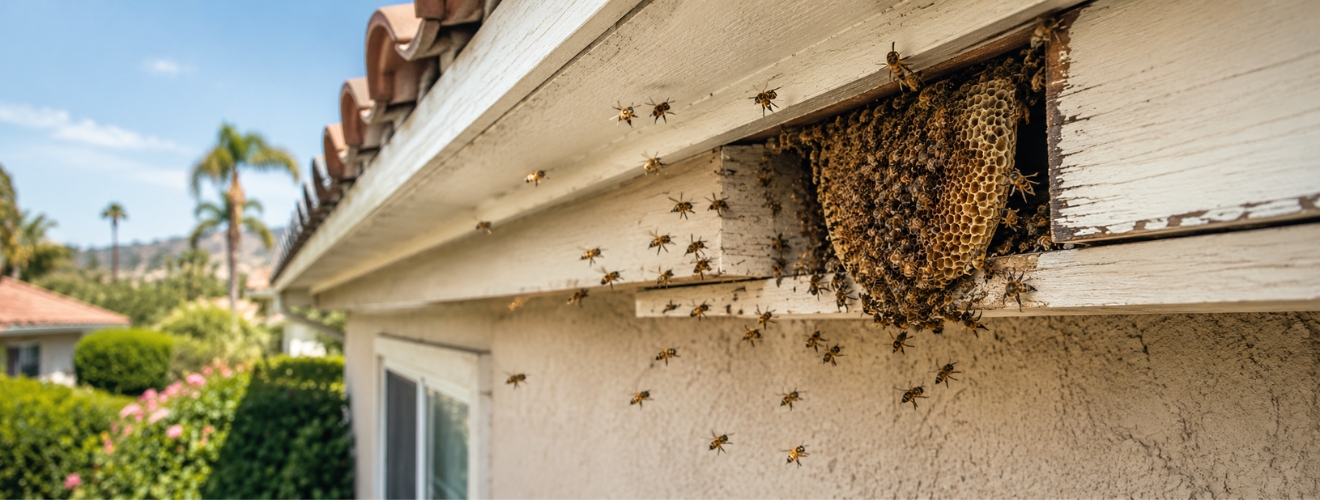
Finding a beehive on your property can be unsettling, particularly when you notice bees steadily entering and leaving an opening in a wall, roofline, or tree. A few bees visiting flowers in the yard is normal and helpful. A steady stream of bees moving in and out of the same spot, however, usually means a colony has established itself nearby. Knowing how to respond protects your household and makes professional removal easier.
Tell the Difference Between a Swarm and an Established Hive
A cluster of bees and an established hive are two different situations. A swarm is a temporary group of bees resting on a branch, fence, or wall while scout bees search for a permanent home, and swarms often move on within a few hours or days. An established hive is a colony that has moved into a cavity and begun building comb. You can usually recognize an established hive by bees consistently flying in and out of a single gap, a low humming sound inside a wall, or dark staining where honey has accumulated.
Identifying which situation you are dealing with matters, because the two call for different responses. A resting swarm may relocate on its own, while a colony that has settled into a structure will not leave and will continue to grow. Waiting to see whether an established hive disappears only gives the colony more time to expand and build comb.
Steps to Take Right Away
While you wait for a professional inspection, take the following precautions:
- Keep children and pets away from the area where bees are active
- Avoid standing in the flight path the bees use to enter and exit
- Do not seal or block the opening the bees are using
- Do not spray the hive with water, insecticide, or any household product
- Note the location and, if you can do so safely from a distance, how long the bees have been present
These simple steps reduce the risk of stings and give the technician accurate information to work with. This matters in our area, where Africanized honey bees are established and a disturbed colony can react defensively in large numbers.
Why You Should Not Seal or Spray the Hive
Blocking the entrance of an established hive often makes the problem worse. Trapped bees may search for another way out and chew through drywall into living spaces. Sealing the colony inside also traps the comb and honey, which can melt, rot, and seep through walls, leaving stains, odor, and damage that attract ants, rodents, and other pests. Store-bought sprays rarely reach an entire colony inside a wall, and any bees and comb left behind continue to cause problems. Removing a hive properly means taking out the bees, the comb, and the honey, then cleaning and sealing the space so the structure is protected.
Honeybees play an important role in pollination, so a colony on your property is worth removing carefully rather than destroying. BeeCal Pest Management inspects the site, removes the colony using humane methods, and seals the area to prevent another swarm from moving in. If you have found a hive on your home or in your yard, contact BeeCal Pest Management to schedule an inspection and request a free quote.