
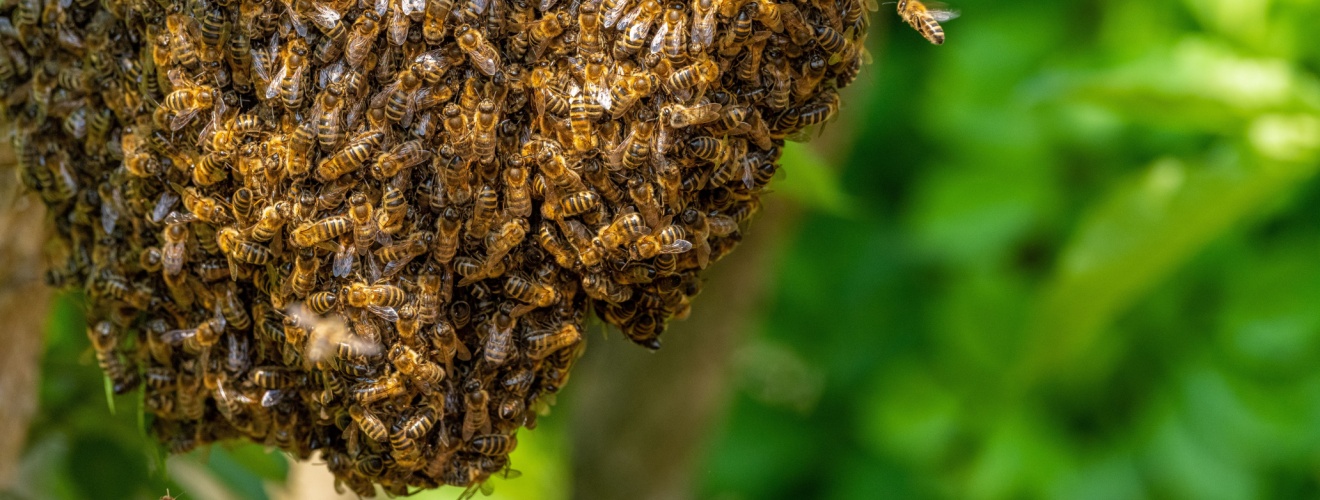
Each spring, homeowners across Los Angeles County notice large clusters of bees gathered on tree branches, fences, and the eaves of their homes. These clusters are honeybee swarms, and they appear in greater numbers during spring than at any other time of year. Understanding why swarming happens and why it is so common in our region helps homeowners respond safely when a swarm settles on their property.
What a Honeybee Swarm Actually Is
Swarming is the natural way a honeybee colony reproduces. When an established colony grows large and the hive becomes crowded, the workers raise a new queen. The original queen then leaves the hive along with roughly half of the worker bees to establish a new colony somewhere else. The departing group is what people see as a swarm. The bees often gather in a temporary cluster on a branch, fence post, or wall while scout bees search the area for a permanent place to build a hive.
Why Spring Triggers Swarming
Spring provides the conditions honeybee colonies need to grow quickly. Flowers bloom across Los Angeles neighborhoods, which gives bees a steady supply of nectar and pollen. Warmer temperatures allow the queen to lay more eggs, and the colony population rises rapidly. As the hive fills with bees, space becomes limited, and crowding is one of the main signals that prompts a colony to swarm. For this reason, the majority of swarms occur from late winter through spring and into early summer.
Why Swarms Are Especially Common in Southern California
Our mild climate extends the swarming season well beyond what colder regions experience. Plants in Los Angeles County begin blooming early in the year, and many continue flowering for months, so colonies start building up sooner and stay productive longer. This gives honeybees more opportunities to reproduce and relocate.
Southern California is also home to Africanized honey bees, which have been established throughout Los Angeles County since the 1990s. Africanized honey bees swarm more frequently and over a longer portion of the year than European honey bees. They also defend their colonies far more aggressively, responding in greater numbers and pursuing people and pets over longer distances. Africanized and European honey bees look identical, and only laboratory analysis can tell them apart. Because there is no way to identify a swarm by sight, every swarm in our area should be treated as a potential safety risk.
Where Swarms Tend to Settle Around the Home
As scout bees look for a permanent location, they are drawn to enclosed cavities that offer shelter. Around Pasadena, South Pasadena, and Highland Park homes, swarms frequently move into:
- Wall voids and spaces behind stucco or siding
- Chimneys and attic vents
- Water meter boxes and irrigation valve boxes
- Sheds, garages, and crawl spaces
- Gaps beneath eaves and rooflines
Once a swarm moves into one of these spaces and begins building comb, the situation changes from a temporary cluster to an established hive, which is more difficult and more expensive to remove.
What to Do If a Swarm Appears on Your Property
A clustered swarm may appear calm, but the bees can become defensive quickly, particularly in a region where Africanized genetics are common. Spraying the swarm, throwing water, or attempting to knock it down can provoke a defensive response and put your household at risk. Children and pets should be kept indoors and away from the area.
The safest and most effective response is to contact a professional who is trained in live bee removal. At BeeCal Pest Management, we specialize in humane honeybee removal and relocation. Whenever possible, we capture the colony alive and rehome it with local beekeepers rather than exterminating it, which protects both your property and an important pollinator. Our technicians can also locate and remove established hives inside walls and other structures, then clean and seal the area to discourage future swarms.
If you have noticed a swarm or suspect bees are nesting on your property this spring, reach out to BeeCal Pest Management for a free quote. We will assess the situation and relocate the colony safely, with the health of your family and the bees in mind.